Quick answer
For osteoporosis and bone health, the NIH and the Bone Health & Osteoporosis Foundation recommend two kinds of exercise: weight-bearing activity like walking or stair climbing, and muscle-strengthening work like resistance bands or light weights, plus balance training to lower fall risk. Avoid bending forward from the waist, especially with a load, and twisting your spine to its limit.
Key takeaways
- Bone responds to weight-bearing and muscle-strengthening exercise.
- Balance and posture work help lower the risk of falls, which cause many fractures.
- Avoid toe touches, sit-ups, crunches and lifting with a rounded back.
- Avoid twisting your spine to its limit, especially with a load.
- If you have had a fracture or have very low bone density, ask your doctor or a physical therapist for a tailored plan.
Osteoporosis makes bones thinner and more likely to break, often without any symptoms until a fracture happens. Exercise cannot replace medical treatment, but the NIH Osteoporosis and Related Bone Diseases National Resource Center describes it as an important part of building and keeping strong bones. The right exercise also improves balance and strength, which helps prevent the falls that lead to many fractures.
This guide explains which types of exercise support bone health, gives you seven safe moves to start with, and lists the movements to avoid.
What kind of exercise is best for bones?
The NIH and the Bone Health & Osteoporosis Foundation (BHOF) point to two main types of bone-building exercise:
- Weight-bearing exercise: activities where your feet and legs carry your body weight, such as walking, stair climbing, dancing and low-impact aerobics. Swimming and cycling are good for your heart but are not weight-bearing.
- Muscle-strengthening exercise: working against resistance, such as resistance bands, light dumbbells or your own body weight.
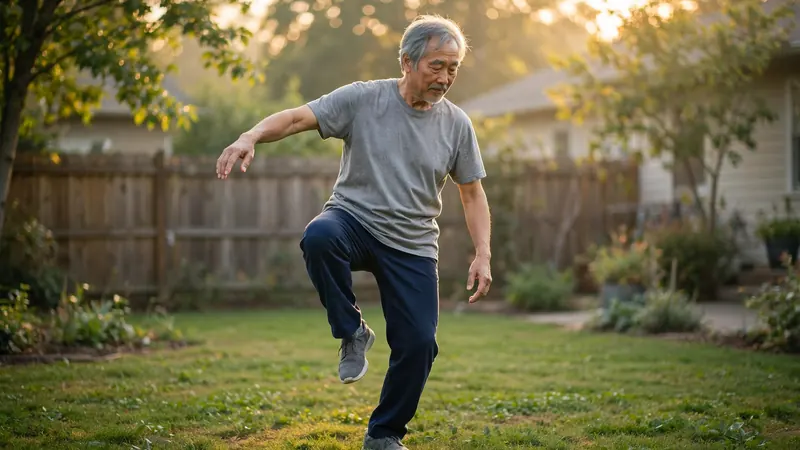
BHOF also recommends balance, posture and functional exercises. These do not build bone directly, but they help you move safely in daily life and lower your chance of falling.
| Type | Examples | Why it matters |
|---|---|---|
| Weight-bearing | Brisk walking, stair climbing, dancing | Puts healthy stress on hip and leg bones |
| Muscle-strengthening | Sit-to-stands, band rows, wall push-ups | Muscles pulling on bone support bone strength |
| Balance and posture | Single-leg stands, tai chi, posture work | Helps prevent falls and supports an upright spine |
Movements to avoid with osteoporosis
The NIH and BHOF both caution people with osteoporosis against certain movements that put extra stress on the bones of the spine:
- Bending forward from the waist, especially with a load. This includes toe touches, sit-ups, crunches and picking things up with a rounded back. This kind of loaded spinal flexion is linked to compression fractures in the spine.
- Twisting your spine to its limit, such as forceful golf or tennis swings or deep seated twists.
- High-impact moves like jumping or running, if you have low bone density or have had a fracture, unless your doctor has cleared you.
Instead, learn to bend at your hips and knees with a straight back, called a hip hinge. It protects your spine during everyday tasks like loading the dishwasher or lifting a laundry basket.
Safer swaps for everyday movements
Many risky movements happen outside of workouts. These swaps keep your spine long:
| Instead of | Try |
|---|---|
| Bending over to pick something off the floor | Squat or kneel with a straight back, holding a counter for support |
| Sit-ups or crunches for your core | Pelvic tilts lying down, or standing tall and tightening your stomach |
| Toe-touch stretches | Seated hamstring stretch with a straight back, leaning from the hips |
| Twisting to look behind you in the car | Turn your whole body, or use mirrors |
| Carrying a heavy bag on one side | Split the load between two hands and hold it close |
7 safe exercises for bone health at home
These moves follow the guidance above: they load the legs and hips, strengthen the back and keep the spine long. Start with 1 set, move slowly, and keep a chair or counter nearby for support.
The exercises
Sit-to-Stand
Works: Hips, thighs, glutes8-12 reps, 1-2 sets
- Sit near the front of a sturdy chair placed against a wall, feet flat and hip-width apart.
- Keep your back straight and lean forward from your hips, not your waist.
- Push through your heels to stand up tall.
- Reach your hips back and lower slowly to sit.
- Make it easier
- Use the armrests or a higher seat.
- Make it harder
- Cross your arms or take 3 seconds to sit down.
- Safety tip
- Keep your chest lifted and spine long; avoid slumping forward.
Heel Raise
Works: Calves, ankles10-15 reps, 1-2 sets
- Stand facing a counter with your hands resting on it.
- Rise slowly onto the balls of your feet.
- Pause for 1-2 seconds.
- Lower your heels slowly.
- Make it easier
- Rise only partway.
- Make it harder
- Use fingertip support only, or one leg at a time.
- Safety tip
- Keep at least one hand on the counter.
Standing Side Leg Raise
Works: Outer hip, balance8-10 reps per side, 1-2 sets
- Stand tall beside a counter, holding it with one hand.
- Keep your toes pointing forward and lift the outside leg out to the side.
- Lift only as far as you can without leaning your body.
- Lower slowly and repeat, then switch sides.
- Make it easier
- Make the lift smaller.
- Make it harder
- Add a light resistance band around your ankles.
- Safety tip
- Keep your trunk upright; do not lean away from the moving leg.
Wall Push-Up
Works: Chest, shoulders, arms8-12 reps, 1-2 sets
- Stand an arm's length from a wall and place your hands on it at shoulder height.
- Keep your body straight from head to heels.
- Bend your elbows to bring your chest toward the wall.
- Push back to the start.
- Make it easier
- Stand closer to the wall.
- Make it harder
- Step your feet farther back, or use a sturdy counter.
- Safety tip
- Keep your back straight and avoid sagging at the hips.
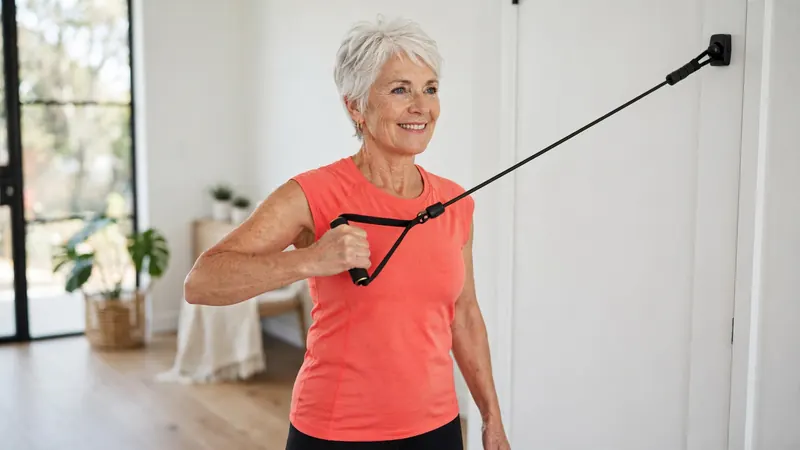
Resistance Band Row
Works: Upper back, posture muscles10-12 reps, 1-2 sets
- Sit tall in a chair. Loop a band around your feet or anchor it in a closed door at chest height.
- Hold one end in each hand with arms straight in front of you.
- Pull your elbows back, squeezing your shoulder blades together.
- Return slowly.
- Make it easier
- Use a lighter band or hold it with more slack.
- Make it harder
- Use a firmer band or pause 2 seconds with shoulder blades squeezed.
- Safety tip
- Keep your back straight; do not round forward as the band returns.
Standing Back Extension at the Wall
Works: Back extensor muscles, posture5-8 reps
- Stand with your back against a wall, heels a few inches from it.
- Gently press the back of your head, shoulders and buttocks toward the wall.
- Tuck your chin slightly and lengthen through the top of your head.
- Hold for 5 seconds, then relax.
- Make it easier
- Hold for 3 seconds.
- Make it harder
- Raise your arms to shoulder height along the wall while you hold.
- Safety tip
- Do not force your head back to the wall if it does not reach; press gently toward it.
Supported Single-Leg Stand
Works: Balance3-5 holds per side
- Stand facing a counter, holding it with both hands.
- Shift your weight onto one leg and lift the other foot slightly off the floor.
- Hold for up to 10 seconds while standing tall.
- Lower the foot and switch sides.
- Make it easier
- Lift only your heel, keeping your toes on the floor.
- Make it harder
- Hold the counter with one fingertip, or hold for 20-30 seconds.
- Safety tip
- Always keep the counter within reach.
How much exercise do you need for bone health?
A practical weekly target, based on the HHS Physical Activity Guidelines:
- Weight-bearing aerobic activity: build up to 150 minutes a week, for example 30 minutes of brisk walking on 5 days.
- Muscle strengthening: 2 or more days a week, working all major muscle groups.
- Balance training: several days a week. Short sessions of 5-10 minutes count.
See our weekly workout schedule for a sample week that fits all three together.
Safety first: when to talk to your doctor
Talk with your doctor before starting if you have already had a fracture, especially in the spine or hip, if you have very low bone density, or if you have back pain that has not been checked. Ask whether a referral to a physical therapist makes sense; they can test your strength and balance and design a program that fits your bone density results. Stop exercising and get medical advice if you feel sudden, sharp back pain, especially after bending or lifting.
Building on these exercises
Falls cause many fractures, so balance practice is one of the most useful things you can add. Start with our balance exercises over 50 and fall prevention exercises at home. When the moves here feel easy, the resistance band workout adds safe progression.
Frequently asked questions
What exercises should you not do with osteoporosis?
Avoid bending forward from the waist, especially with weight, such as toe touches, sit-ups, crunches and lifting with a rounded back. Also avoid twisting your spine to its limit. If you have very low bone density or a past fracture, ask your doctor before doing high-impact moves like jumping.
Is walking good for osteoporosis?
Yes. Walking is a weight-bearing exercise, and the NIH lists it among activities that support bone health. Pair it with strength training on 2 or more days a week for more benefit.
Can exercise reverse osteoporosis?
Exercise alone is not a cure, but it is an important part of protecting your bones, alongside calcium, vitamin D and any medicine your doctor recommends. It also builds strength and balance, which lowers your risk of falls and fractures.
Is yoga safe with osteoporosis?
Some poses are fine, but many yoga poses include deep forward bends or twists, which people with osteoporosis are advised to avoid. Tell the instructor about your diagnosis and skip or modify those poses.
Sources
Health note: This article is general information, not medical advice. If you have a heart condition, high blood pressure, diabetes, recent surgery, joint replacement or any symptoms such as chest pain, dizziness or unusual shortness of breath, talk to your doctor before starting. Stop any exercise that causes sharp pain. Read our full disclaimer.