Quick answer
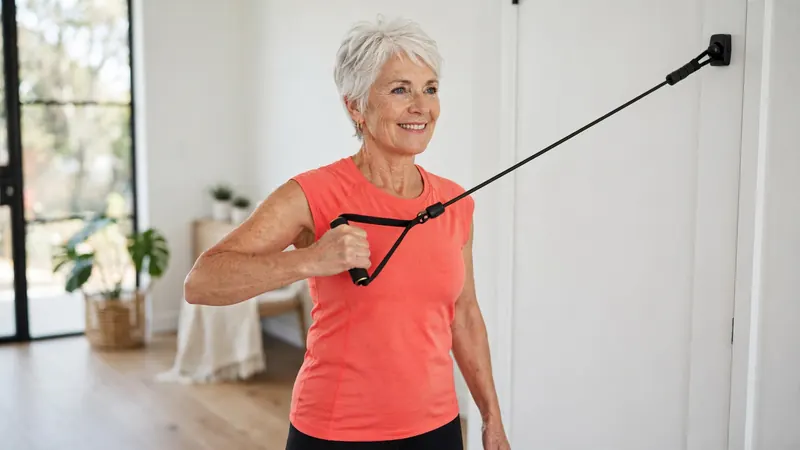
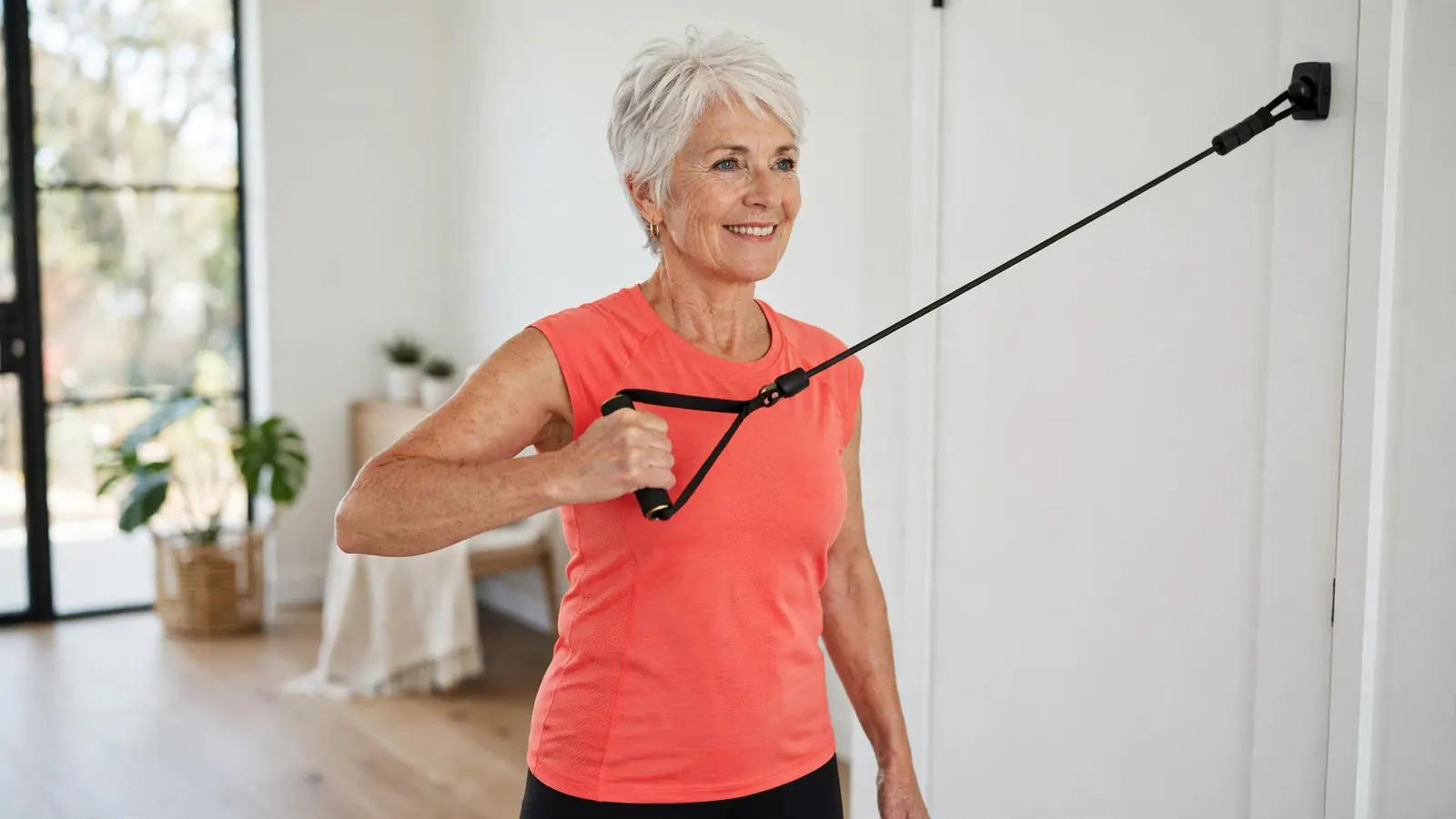
A good resistance band workout for adults over 50 uses 6-8 moves that cover the whole body, such as seated rows, chest presses, pull-aparts, curls, leg presses and side steps. Do 1-3 sets of 10-15 slow reps, 2-3 non-consecutive days a week. Choose a band tension where the last 2-3 reps feel hard but your form stays steady.
Key takeaways
- Bands give smooth, adjustable resistance that is easy on the joints and costs little.
- Do 1-3 sets of 10-15 slow reps of each move, at least 2 days a week (HHS).
- Band colors are not standardized across brands, so choose by feel, not color.
- Check bands for nicks or tears before every session and anchor them securely.
A resistance band is one of the simplest ways to strength train at home after 50. Bands are light, cheap, easy to store, and the tension builds gradually through each movement, which many people find kinder on their joints than free weights. This workout uses 7 moves to cover your back, chest, shoulders, arms, hips and legs in about 25 minutes.
Why use resistance bands after 50?
The Physical Activity Guidelines for Americans recommend muscle-strengthening activity on at least 2 days a week for all adults, including those 65 and older, and they list resistance bands alongside weights and bodyweight exercise as ways to do it. The National Institute on Aging also suggests bands as an easy way to add strength work at home.
- Joint-friendly: resistance starts light and rises as the band stretches, so there is less jolt at the start of a lift.
- Adjustable: step closer to the anchor or choke up on the band to make a move easier, or step away to make it harder.
- Works in any direction: bands let you train pulling movements for your back, which are hard to do with bodyweight alone.
Which type of resistance band should you buy?
| Band type | What it looks like | Best for |
|---|---|---|
| Tube with handles | Rubber tube with a handle on each end, often with a door anchor | Rows, chest presses, curls; easiest to grip |
| Flat therapy band | Long, flat latex strip, no handles | Light upper-body work and rehab-style moves |
| Mini loop band | Small closed loop, about 10-12 inches | Side steps and hip work, placed above the knees |
A set of 3 tensions (light, medium and heavy) covers most people for many months. Colors are not standardized across brands, so compare the listed tension and choose by feel. If you have a latex allergy, look for latex-free bands. If gripping is hard because of arthritis in your hands, tube bands with padded handles are usually the most comfortable.
How many sets and reps should you do?
Do 1-3 sets of 10-15 reps of each move on 2-3 non-consecutive days a week. Start with 1 set while you learn the moves. HHS guidelines say strength work is most effective when you go until it would be hard to do another rep with good form, so pick a band and position where the last 2-3 reps take real effort.
Control the band in both directions. Take about 2-3 seconds to pull and 2-3 seconds to return. Letting the band snap back wastes half the exercise and can strain your joints.
The 7-move resistance band workout
Warm up first by marching in place and circling your arms for 3-5 minutes. Then work through the moves in order, resting 30-60 seconds between each. Every move can be done seated in a chair or standing, so you never need to get down on the floor.
The exercises
Seated Band Row
Works: Upper back, rear shoulders, biceps1-3 sets of 10-15 reps
- Sit tall in a sturdy chair facing a closed door with the band anchored at chest height, or sit on the floor with legs extended and the band looped around your feet.
- Hold a handle in each hand with arms straight in front of you and the band slightly taut.
- Pull your elbows back close to your sides, squeeze your shoulder blades together, then return slowly.
- Make it easier
- Move closer to the anchor to reduce tension.
- Make it harder
- Move farther away or use a heavier band.
- Safety tip
- Keep your shoulders down away from your ears and your back upright; do not lean back to finish the pull.
Band Chest Press
Works: Chest, front shoulders, triceps1-3 sets of 10-15 reps
- Sit in a chair and wrap the band around the chair back or your upper back, holding a handle in each hand at chest level.
- Press both hands straight forward until your arms are nearly straight.
- Return slowly to the start without letting your elbows drift behind your body.
- Make it easier
- Use a lighter band or press one arm at a time.
- Make it harder
- Use a heavier band or pause for 2 seconds with arms extended.
- Safety tip
- Keep wrists straight and stop short of locking your elbows.
Band Pull-Apart
Works: Upper back, rear shoulders, posture muscles1-3 sets of 10-15 reps
- Sit or stand tall holding a flat band or tube with both hands, arms straight out in front at shoulder height, hands about shoulder-width apart.
- Pull your hands apart and out to the sides, squeezing your shoulder blades together.
- Return slowly with control.
- Make it easier
- Hold the band with hands wider apart.
- Make it harder
- Hold hands closer together for more tension.
- Safety tip
- Keep a small bend in the elbows and do not shrug your shoulders.
Band Biceps Curl
Works: Biceps, forearms1-3 sets of 10-15 reps
- Stand or sit with the middle of the band under both feet, holding a handle in each hand, palms facing forward.
- Keeping elbows at your sides, curl your hands up toward your shoulders.
- Lower slowly over 2-3 seconds.
- Make it easier
- Stand on the band with one foot only to reduce tension.
- Make it harder
- Stand with feet wider apart or use a heavier band.
- Safety tip
- Make sure the band is secure under your feet before you pull, so it cannot slip.
Seated Band Leg Press
Works: Thighs, glutes1-3 sets of 10-15 reps per leg
- Sit tall in a sturdy chair and loop the middle of the band around the sole of one foot, holding the ends in both hands.
- Bring that knee toward your chest, then press the foot forward until your leg is nearly straight.
- Bend the knee back slowly. Finish all reps, then switch legs.
- Make it easier
- Hold the band with more slack.
- Make it harder
- Shorten the band or use a heavier one.
- Safety tip
- Wear shoes so the band does not slip off your foot, and keep the band out of line with your face.
Band Triceps Press-Down
Works: Triceps1-3 sets of 10-15 reps
- Anchor the band at the top of a closed door, or loop it over a sturdy high anchor.
- Hold the ends with elbows bent at your sides and hands at chest height.
- Press your hands down until your arms are straight, then return slowly.
- Make it easier
- Step closer to the door.
- Make it harder
- Step back or use a heavier band.
- Safety tip
- Keep your elbows pinned at your sides and the door fully shut.
Mini-Band Side Step
Works: Outer hips, glutes, balance2-3 trips of 8-10 steps each way
- Place a mini loop band just above your knees and stand with feet hip-width apart, knees slightly bent, near a counter.
- Step your right foot 8-12 inches to the side, then bring your left foot to follow, keeping tension on the band.
- Take 8-10 steps one way, then come back the other way.
- Make it easier
- Use a lighter band or no band and take smaller steps.
- Make it harder
- Move the band down to just above your ankles.
- Safety tip
- Stay close to a counter or wall for support and keep your toes pointing forward.
How do you make a band workout harder over time?
When you can do 3 sets of 15 reps with good form, it is time to progress. Try these in order:
- Shorten the band by choking up on it or stepping farther from the anchor.
- Add a 2-second pause at the hardest point of each rep.
- Move up to the next band tension and drop back to 10 reps.
Change one thing at a time. If you are new to strength training, our beginner's guide to strength training after 50 explains progression in more detail.
Safety first: band tips and when to talk to your doctor
- Inspect the band before every session. Replace it if you see nicks, tears, sticky spots or thinning; a worn band can snap.
- Anchor securely. If you use a door anchor, place it on the hinge side of a door that closes away from you, and make sure the door is shut and locked so no one opens it mid-set.
- Keep the band away from your face and never point a stretched band toward your eyes.
- Keep wrists straight and avoid wrapping the band tightly around your hands or fingers.
- Breathe out as you pull or press, and never hold your breath.
Check with your doctor before starting if you have a heart condition, uncontrolled high blood pressure, a recent surgery or joint replacement, or shoulder problems. If your shoulders feel tight, our shoulder mobility exercises make a good warm-up.
A simple weekly band plan
Do this workout on Monday and Thursday, or Tuesday and Friday. On other days, walk or do balance practice, since the CDC recommends that older adults combine strength work with 150 minutes of moderate aerobic activity and balance training each week. When you are ready for no-equipment variety, add our upper body workout without equipment.
Frequently asked questions
Are resistance bands as good as weights for people over 50?
For most home exercisers, yes. HHS guidelines count resistance bands as muscle-strengthening activity, and bands can challenge muscles enough to build strength when you use a tension where the last few reps are hard.
What resistance band should a beginner over 50 start with?
Start with a light or medium band, ideally a tube with handles if you have grip concerns. Since colors differ by brand, choose a band you can pull 10-15 times with good form while the last 2-3 reps feel hard.
How often should I do a resistance band workout?
Two to three times a week on non-consecutive days, such as Monday and Thursday. This meets the HHS recommendation of muscle-strengthening activity on 2 or more days a week.
Can resistance bands snap?
They can if they are worn or damaged. Inspect your band before each use for nicks, tears or sticky spots, keep it away from sharp edges and direct sunlight, and replace it at the first sign of wear.
Sources
- HHS: Physical Activity Guidelines for Americans
- CDC: Older Adult Activity: An Overview
- National Institute on Aging (NIH): Exercise and Physical Activity
- MedlinePlus (NIH): Exercise for Older Adults
Health note: This article is general information, not medical advice. If you have a heart condition, high blood pressure, diabetes, recent surgery, joint replacement or any symptoms such as chest pain, dizziness or unusual shortness of breath, talk to your doctor before starting. Stop any exercise that causes sharp pain. Read our full disclaimer.